
We’re Changing How We Travel
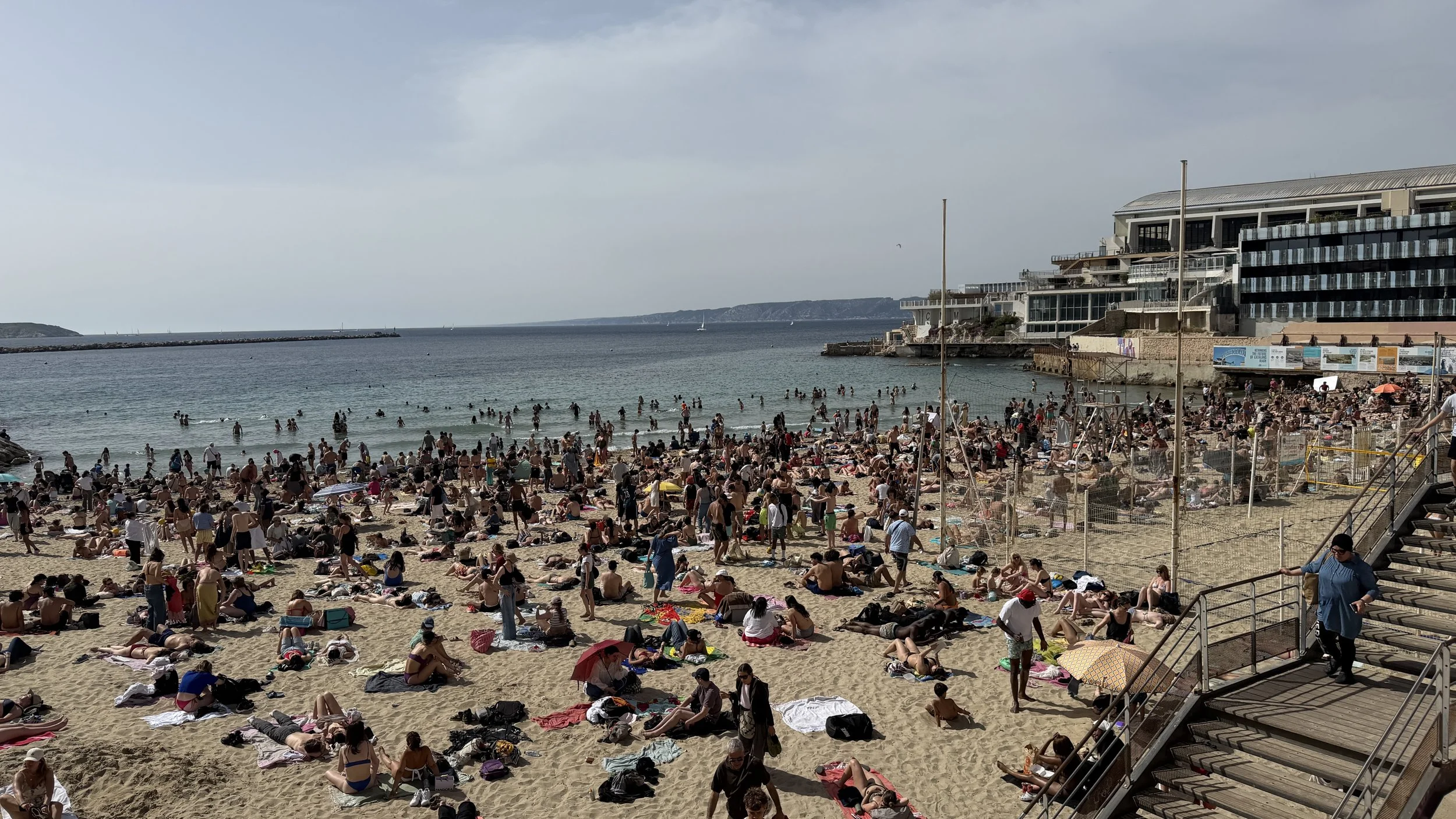
Beach in Marseille, France (April 2026)
In the middle of April, when we were in Marseille, France, we couldn’t believe how crowded it was. We’d been there several times before and had never seen this many people wandering the Old Port.
We later learned there were multiple cruise ships in town bringing more than 32,000 passengers into Marseille over the weekend…17,000 one day and 15,000 the next. It was crazy. It simply wasn't fun anymore. There were too many people for us.
One of the reasons we travel during the off and shoulder seasons is that we want there to be fewer people.
One of the things we realized is that it isn’t just time of year now, it’s also the location. Some places have become overtouristed and it’s affecting not just the traveler’s experience, but more importantly, it’s negatively impacting the quality of life for the people who live there.
There has to be a better balance whereby visitors can explore and experience beautiful and amazing places, AND the local people and economies can benefit from traveler dollars.
Lower costs and fewer barriers to international travel mean more people are able to travel than ever before. Think about what it was like to book a trip to Europe before the internet? Google Translate also makes it easier to get around and communicate when in foreign locales.
Instagram, TikTok, and YouTube have created what is called concentrated tourism. People see the same places over and over again and naturally want to experience them for themselves. When a lot of people want to see and take pictures of the same thing, it can ruin the experience for everyone.
Cruise ships have gotten humongous and bring thousands of passengers into a city at once. While these cities can accommodate lots of visitors over time, they're not designed to accommodate thousands of additional people arriving all at once during the daytime hours.
Platforms like Airbnb and VRBO have created a whole new rental economy, jacking up housing prices, squeezing out the locals, and changing entire neighborhoods. Housing that once served local residents is increasingly being converted into short-term rentals in some cities, changing neighborhoods and reducing the supply of housing available to locals.
In the US, we are finding everything more expensive, and our dollar is not going as far, really, anywhere. At the same time, growing middle classes in many parts of the world mean millions more people are now able to travel internationally than a generation ago. In 1950, international arrivals were 25 million. Today it is 1.5 billion (with a B).
And we can’t forget about pent up demand created by the Covid pandemic. I expected that this would have dissipated, but I was wrong. If anything, it’s getting worse.
Not everywhere is experiencing the same level of overtourism. While there is a perfect storm of conditions contributing to some places being overtouristed, there are a lot of places that are still incredible to visit.
And this is where you find us, actively searching for places that have yet to be super popular, or may never be.
We have been fortunate to visit many of the world's most popular destinations already. You might say that it’s easy for us to say, go somewhere else, and I wouldn’t disagree.
We have yet to go to Japan, and we want to, but our friends visited recently and discovered that some local restaurants had signs that said “Japanese only.” That was one signal to us that maybe now isn't the right time for us to visit.
Cities are responding in different ways. Some cities are levying additional taxes or fees upon visitors (Venice, Italy), and other cities are capping the number of short-term rentals by neighborhood (Palm Springs, California), or instituting short-term rental licensing (Madrid, Spain).
I don’t know what the right answers are to this very complicated and fascinating problem, but I know that we can choose to travel differently and we are.
We are in the middle of planning our fall trip, and we've postponed Scandinavia for the time being. Instead, we're researching the Balkans—Albania, North Macedonia, Montenegro, Bosnia & Herzegovina, and a little bit of Croatia because they appear to be less affected by overtourism.
We don’t want to stop traveling but we do want to stop contributing to a problem that ends up affecting not just people but the environment as well.
How are you thinking about travel and overtourism these days? Let us know in the comments or send us an email at zekeandterri@gmail.com
Finally, while Marseille was definitely busy for two of the four days we were there, we're still huge fans of the city. Watch our Don't Skip Marseille video to see what we loved, what challenged us, and how we'd visit Marseille again.
❤️Terri