
The (Iterative)Art of Trip Planning
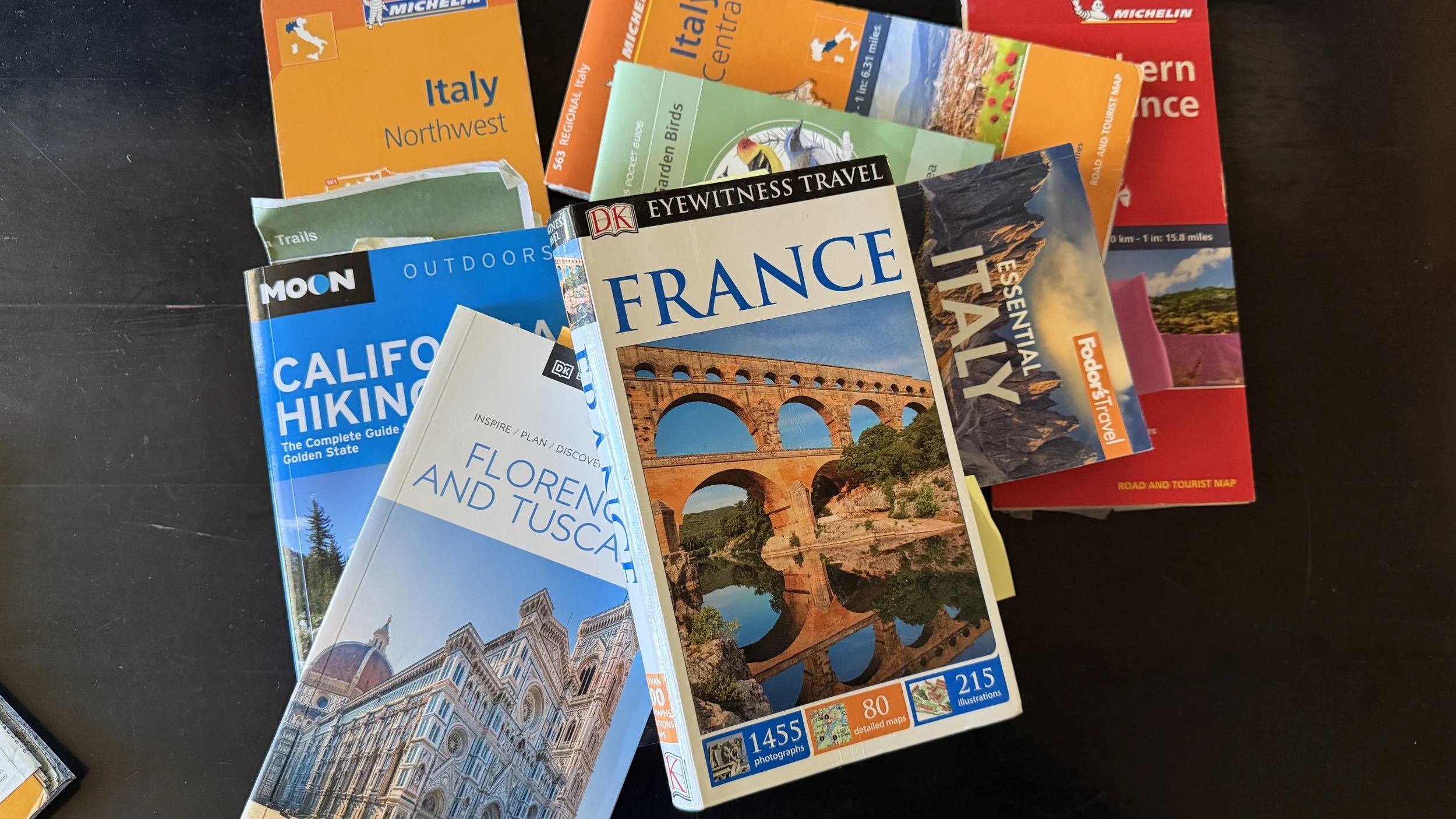
A small sampling of our guidebook library
It always amazes me how our big trips come together. We may not end up with the trip we thought we'd go on, but ultimately we go somewhere and have a memorable time.
The path from idea to departure, and even return home, however, is rarely straightforward.
Idea to the Initial Plan: The System
We start with an idea or a theme and build it using a series of spreadsheets to track To Do’s/action items, the itineraries (yes, plural), ideas, booked activities, trip costs. It’s not just a process, it’s a system.
We've learned that trip planning isn't about finding the perfect itinerary. It's about creating a process that allows us to explore possibilities, test assumptions, change our minds, and gradually discover what kind of trip we actually want to take.
I copy a previous trip, remove the data, and start, usually with the ideas tab. Why not just create a template? That’s a great idea which is why I plan to do just that as I procrastinate writing this blog post. Stand by.
Ok, that’s now done and out on Patreon for our Travel + Midlife Insiders subscribers and It’s back to sharing our process.
Research Phase
The planning process typically requires a fair bit of research and negotiations. If you’ve spent any time with us, either virtually through our videos or in person, you know just how different we are. And while travel may be the connective tissue in our rebooted relationship, we still have very different wants and needs in life and when we travel.
I watch a lot of YouTube videos to get a sense of a place and where we should consider going. I may buy guidebooks to flip through but I do less of that now than I used to as I’ve been using ChatGPT or Claude for both basic and detailed research. I always sanity check what I learn to avoid hallucinations. I add ideas to the Ideas tab as I learn about something.
Zeke also watches YouTube videos and reads articles that come to him through the various platforms like Facebook or Instagram. The algorithms seem to be listening to our conversations. Sometimes he’ll just Google. One thing I just learned is that he'll also spend time looking at maps, and interesting things will pop up for him. He may or may not populate the Ideas tab of the spreadsheet. And if he does, he usually populates the fields incorrectly.
Building Itinerary #1
Then we start building an itinerary based on how long we think we want to spend in a place and how we'll get from one place to the next.
We then sanity check places and dates to make sure that multiple cruise ships won’t be in port at the same time, checking on holiday schedules, and even big events that may be in town. Then we check flight and train schedules to see what constraints we are dealing with.
Building Itineraries #2-#9
Usually, that leads to Itinerary #2. I copy the first itinerary tab and create a second one, and then move the first to the end of the list.
We continue to research and explore options and add to the Ideas list. We spend 2-3 months planning a trip and lock in critical elements (like flights, trains, first nights’ lodging) about two months before departure.
As we reject places and ideas, I move them down to an Old Ideas section of the Ideas spreadsheet. I don’t want to lose our research because we may want it for another trip, a friend might ask for it, or it might get pulled back into the active Idea list as we move through itineraries.
For the fall Scandinavia trip, we pulled in Helsinki and Tallinn, then kicked out Tallinn, then kicked out Helsinki, then brought Helsinki back in, and ultimately, brought Tallinn back in. We are currently on Itinerary 9 for that trip with only airfare booked.
Booking Flights
Once we think we have a fairly solid itinerary, we look at the price of flights, trains, and car rental to sanity check and make sure we can afford the plan. The first thing we book is our airfare and depending on prices, that may change the itinerary like our fall trip. We thought we were going to fly in and out of Paris but it ended up being 25% less to fly into Amsterdam over Paris.
Once we have the main flights booked, we let the itinerary sit for a bit. It gives us a break from the intense conversations and the shock of airfare prices before we pick it back up and continue refining the plan.
Lodging and Activities
The itinerary still isn’t locked in at this point. We have no hotels or Airbnb’s booked. We most likely don’t have any trains, cars, or other airfare booked so the inside of the trip is still completely malleable.
We'll share what we are planning with other people and learn more about places, things to do, and things to avoid. This is a surprisingly helpful step on several levels. It helps me verbally process what we're doing and gives us another opportunity to bounce ideas off each other.
There's still tension, by the way.
We’ll then start researching places to stay. Zeke generally looks at Airbnb’s and I look at hotels.
As items are booked, the data is updated on the Itinerary spreadsheet and added to the Trip Costs spreadsheet. I will update the Trip Costs throughout our trip.
If we book activities like tours or museums in advance, these are added to the Activities tab for quick reference. Admittedly, I’m not always consistent about updating this tab, especially if I have the details, including notes, on the Itinerary tab.
We will continue to refine the plan and create new itineraries if there are significant changes. I like to see the history and the progression, and it’s not uncommon for us to go back and grab something from a previous itinerary.
If you are imagining this as one big jigsaw puzzle, you have the right image, except with our trip planning, it’s more like having multiple jigsaw puzzles or extra pieces in the box. Some fit, some don’t.
Why We Leave Parts Unplanned
We’ve traveled enough at this point that we often book lodging or cars a day or two before we need them. This also gives us some flexibility in the event that we learn about something interesting on the road or we just don't want to plan a section until we get to a place. We did that with Brittany while on our Spring 2026 trip and we also did that when we met up in Nancy, France last fall. Two years ago this would have stressed me out. Today, I think it's part of the fun.
For our Fall 2026 trip, it is possible that this summer, we book flights to Copenhagen to meet up after our solo trips, and then decide from there. This is one of the benefits of traveling during the off-season. There’s usually availability.
Bringing It Home
Trip planning isn't a smooth or linear process for us. I have major FOMO. Zeke occasionally proposes things without considering small details like weather, transportation, or whether there's anything to do once we get there besides cycle or hike.
Somehow, through a combination of spreadsheets, research, negotiations, revisions, and the occasional spirited discussion, we eventually arrive at a plan.
Then we leave home and immediately start changing it.
After all, travel is an adventure, not a project plan.
Which is probably a good thing, considering one of us is a professional project manager.
One Last Thing
If you'd like a copy of the spreadsheet template we use to plan our trips, it's available for our Travel + Midlife Insiders on Patreon.